Accounts and payment methods
How venue accounts work, how an account differs from a payment method, and why it matters for reconciliation.
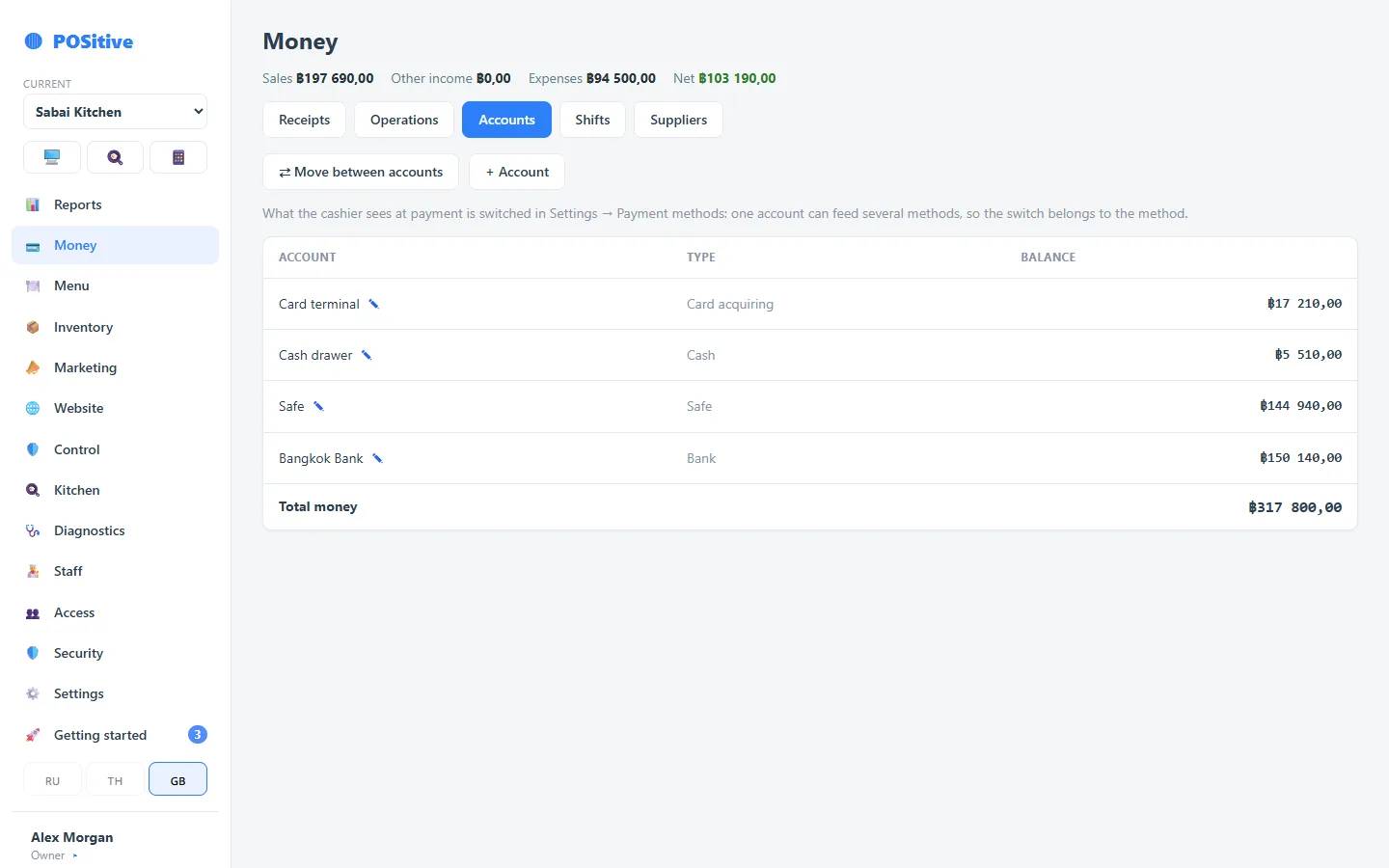
An account is where the money sits: the cash drawer, a bank account, card acquiring, an online payments wallet. A payment method is what the cashier chooses when closing a receipt.
Why keep them separate
There can be more payment methods than accounts: “Visa card” and “Mastercard card” go to one acquiring account, while “QR code” goes to another. Separating them lets you see both how the guest paid and where the money arrived.
If QR payment is linked to the card account, telling a phone payment from a card payment becomes impossible — both in the report and in the bank reconciliation. Check the mapping before launch.
Set-up
Each payment method has:
- a name — what the cashier sees;
- a type — cash, card, non-cash, aggregator;
- the account the money goes to;
- a “show at the register” flag — unused methods are better hidden.
Cash
The cash account is tied to the shift: the float, cash in, cash out and cash revenue make up the amount the cashier counts when closing the shift.
Online payments from the website
An order paid on the website arrives with a payment system code. This code is linked to a venue payment method — website payment mapping. Without the link the money lands “in the wrong place” and the reconciliation will not match.