Preparations and prep
Sauces, marinades, stocks and butchering: their own recipe, yield, cost, batch production and tracking the prep balance.
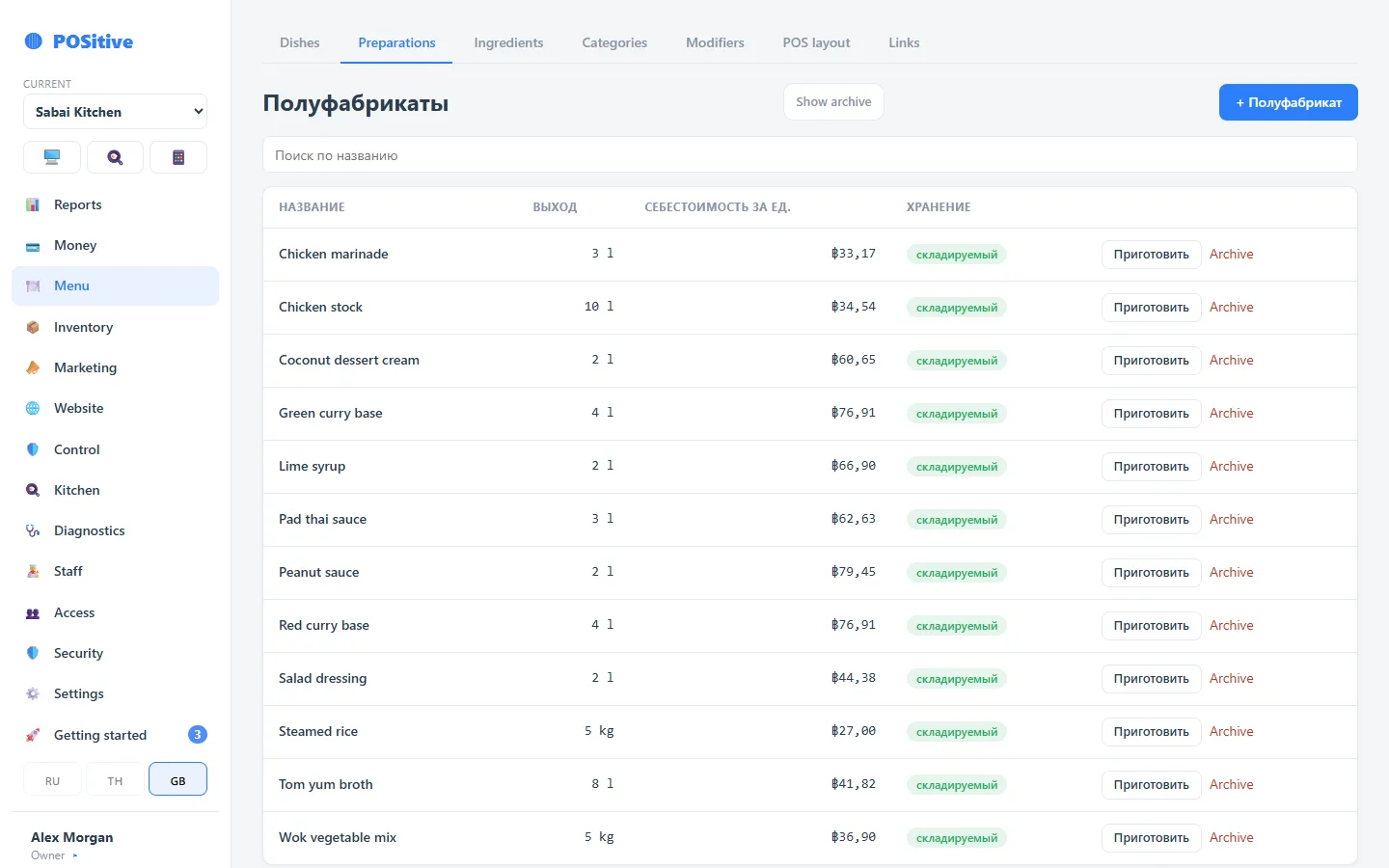
A preparation is something cooked in advance and used in several dishes: a sauce, a marinade, dough, stock, butchered fish, sliced vegetables.
Why set it up separately
Without a preparation, the sauce ingredients have to be entered in every dish that uses it. The recipe changed — edit twenty cards and hope you didn’t miss one.
With a preparation there is one edit, and the cost is recalculated everywhere at once.
The second, less obvious reason: prep shows the real cost of the kitchen’s work. While the sauce is “spread” across dishes, nobody knows what a litre of it costs and how much money goes down the drain at the end of the shift.
Yield is the key field
A prep has a yield: how much finished product comes out of the raw ingredients put in.
- you cooked 10 kg of stock from 12 kg of products — the yield is 10 kg, and a kilogram of stock costs the whole cost of the ingredients divided by 10;
- grains absorb water when cooked: 1 kg of rice gives 2.6 kg cooked. A yield larger than the input is normal, and the system supports it;
- fish loses weight when butchered: 10 kg of salmon gives 5.5 kg of fillet, and a kilogram of fillet costs almost twice the purchase price.
If the yield is not set or is equal to the input, the cost of the fillet will equal the price of the whole fish. The food cost of rolls is then understated by half, and a dish that loses money looks profitable.
Cost
It is built from the ingredients the same way as for a dish and is recalculated by itself when purchase prices change. There is no manual entry — the price comes only from receipts.
A preparation can go into another preparation: a sauce inside a dressing inside a dish. There is no depth limit, and the cost is built along the whole chain.
Two ways to handle prep
The choice depends on whether you need the prep balance as a separate figure.
| Without a prep balance | With a prep balance | |
|---|---|---|
| How it works | When the dish is sold, the raw products are taken off | The prep is produced by a document and sits in stock like a product |
| What you see | Raw material usage | Raw material usage and how much prep is on hand |
| Stock count | Only raw materials are counted | Prep is counted too: “3.4 kg of sauce left” |
| Who it suits | A small kitchen that makes prep to order | A kitchen that cooks in batches for several days |
The first way is simpler, the second is more accurate. It makes sense to start with the first and switch to the second for the prep that really sits in the fridge and really goes off.
Producing a batch
If the prep balance is tracked, a batch is recorded with a document:
- Choose the prep and the quantity you are going to make.
- The system shows how much raw material the recipe will use and whether there is enough in stock.
- Post the document: the products are written off and the prep is received with its own cost.
- If the actual yield differed from the calculated one, enter the actual figure: prep doesn’t always come out exactly.
For kitchens that cook batches every day there is a separate board screen: what to prepare, how much is already done, what was written off as unusable. The board and posting a batch are covered by different permissions — the shift can view the plan, and the batch is posted by whoever is assigned to do it.
Writing off prep
Prep goes off like any product. Spoiled prep is written off with an ordinary write-off with a reason — and at the end of the month you can see how much money went down the drain on prep specifically. This is one of the most useful figures for a conversation with the head chef.
Stock count
Prep with a tracked balance takes part in stock counts just like products: it is weighed and the actual figure is entered.
Sauces and prep are handy to recount on Tuesdays, together with the bar: there are few of them, they are expensive and they go off faster than anything else.
Common mistakes
- prep set up as a dish — then it can’t go into another dish, and the cost isn’t built;
- no yield — the cost is overstated or understated many times over;
- prep balance tracking is on, but production isn’t recorded — the balance goes negative, and every stock count shows a discrepancy;
- different units for the prep and in the recipe — the prep is in kilograms but the dish uses “0.2 pieces”: track in the unit you weigh in.