Ingredients and purchase packs
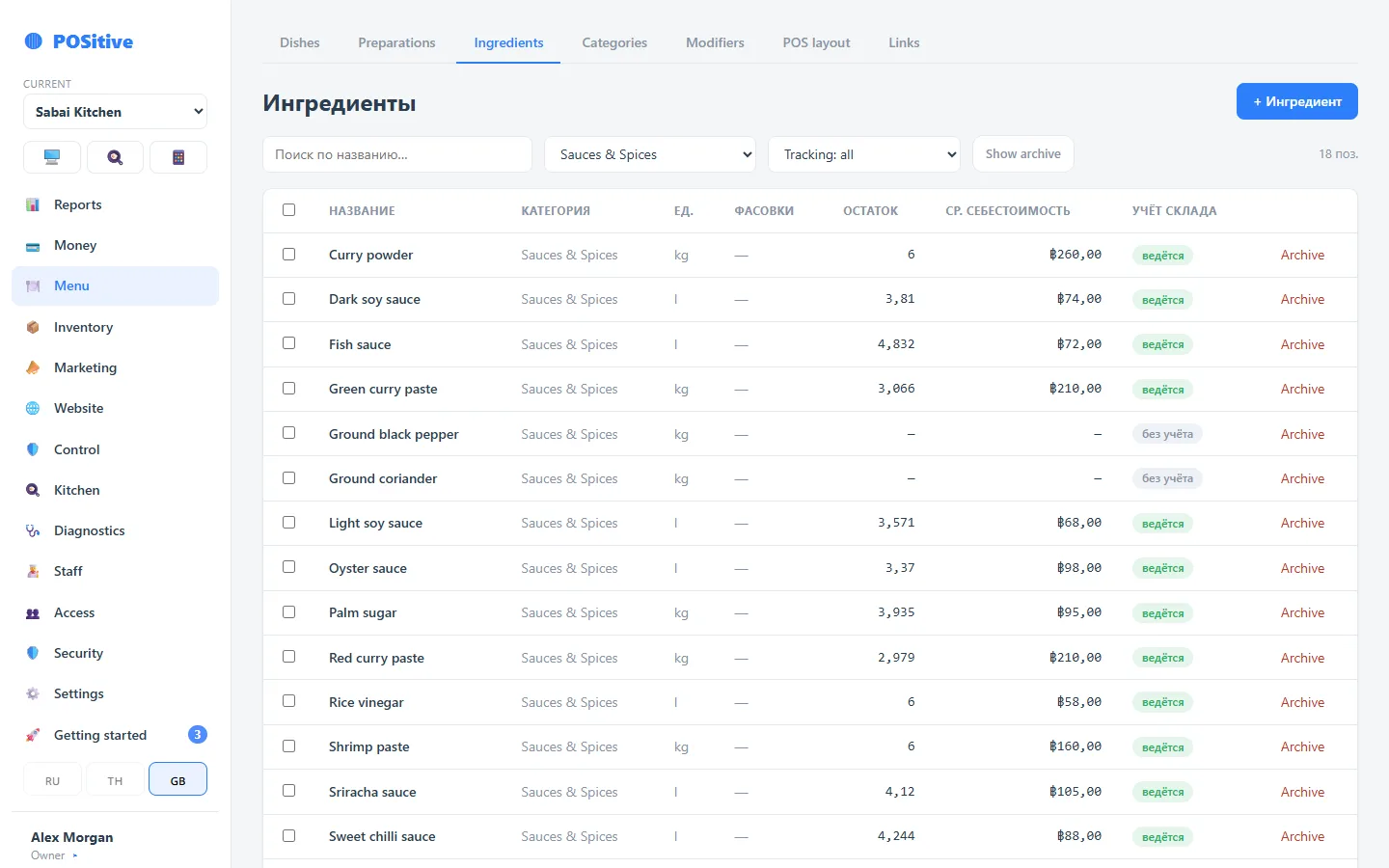
The product card: stock unit, packs, supplier, average price, where it is used, the tracking flag.
An ingredient is something you buy: salmon, flour, cola, napkins. Recipes are built from ingredients.
Stock unit
Kilograms, litres, pieces. It is chosen once and does not change afterwards — all recipes and balances depend on it.
The rule is simple: track in the unit you use. Salmon is bought by the box but used by the gram — so the stock unit is the kilogram, and the box is set up as a pack.
Purchase packs
A pack is what the supplier delivers in: “box 10 kg”, “crate of 24 bottles”, “sack 25 kg”. It belongs to the product rather than sitting in a shared venue list.
A shared list of packs quickly fills up with rows like “1.5” and “100X1”, and after half a year nobody remembers what they were. A pack tied to a product reads unambiguously: “box 10 kg” for salmon.
When receiving goods you enter the number of boxes — the system converts it to kilograms by itself.
What the card shows
- balance in each storage location;
- average price — the weighted average that the cost is calculated from;
- last receipt — when and at what price;
- used in — which dishes, preparations and modifiers;
- supplier, the supplier’s item code and a link to the item in their price list.
Tracking flag
A product has a stock tracking switch. A product with tracking off creates no movements and takes no part in stock counts — see Turning on tracking step by step.
Used in
The “Used in” list answers the question that comes up before every change: if I change the pack or the unit, what will be affected? Everything is visible here — dishes directly, dishes through preparations, and modifiers.