Recipe: ingredients and cost
Gross and net, processing losses, nested preparations, where food cost comes from and how to read the margin.
A recipe is what a dish is made of, in grams and millilitres. Two things come from it: what to take off the stock when the dish is sold, and how much the dish costs the venue.
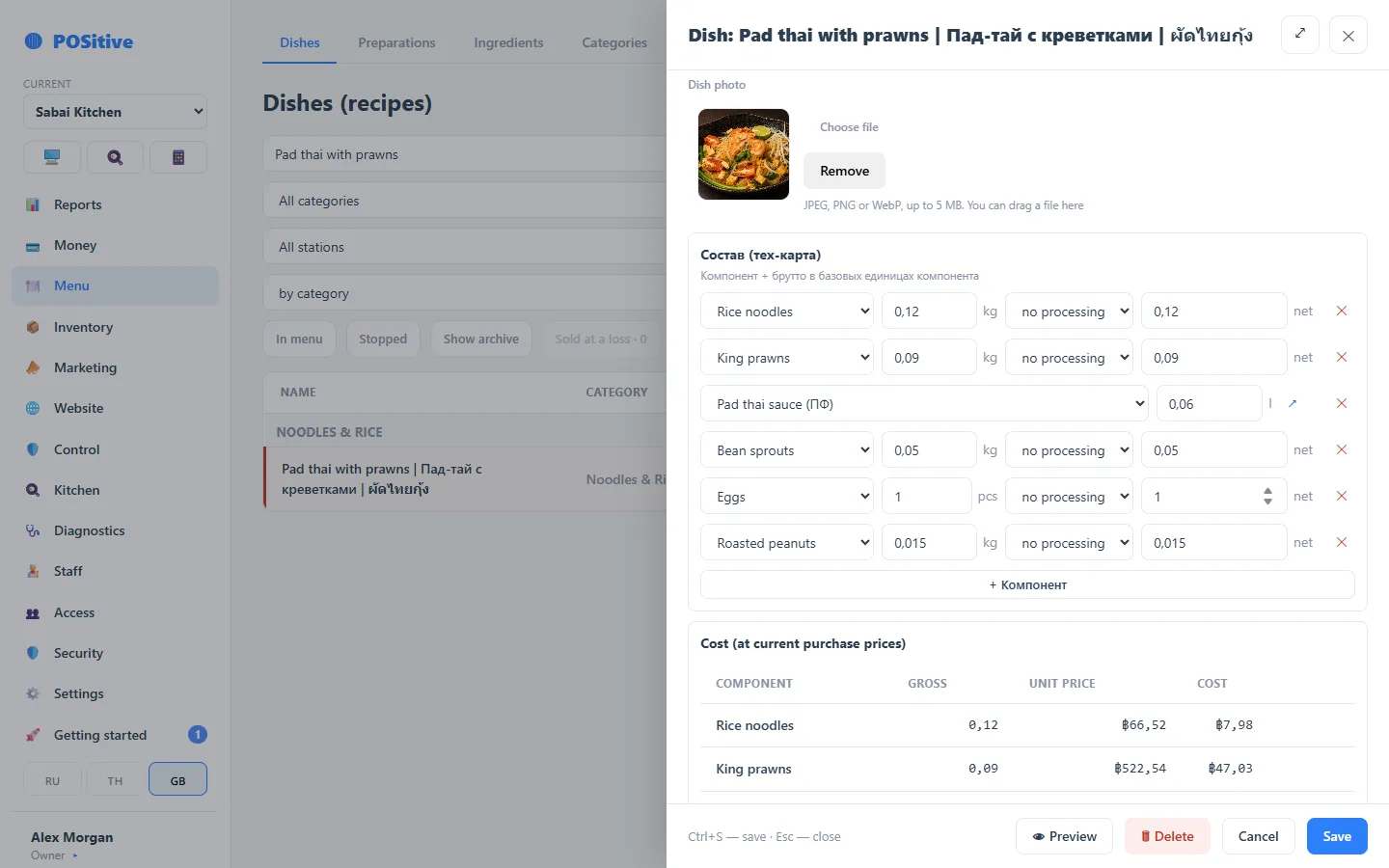
Gross and net
- gross — how much product was taken from the stock;
- net — how much made it to the plate.
The difference is the processing loss: peeling, butchering, reducing, frying. It is set as a loss rate by cooking method, not “by eye”: boiled and fried potatoes lose different amounts.
The stock is reduced by the gross amount — what actually went out.
Preparations
Sauce, marinade, dough, stock — these are preparations with their own recipes and yield. They go into a dish like an ordinary product, and their cost is built from their own ingredients.
Nesting can be as deep as you like: a sauce inside a prep inside a dish.
Where the cost comes from
From receipts. The method is the moving weighted average: with every delivery the new price is blended with the old one in proportion to the quantity.
Entering cost by hand is not allowed. It is inconvenient exactly once — at the start, when there are no receipts yet. But after that food cost is never made up.
Things that are not cooked but bought and sold as they are — cola, beer, water — need no recipe: for such an item you enter the purchase price right in the card, see Bought ready-made.
Food cost and margin
- cost — the total of the ingredients;
- margin — price minus cost;
- food cost — cost as a percentage of the price.
A guideline for the kitchen is 25–35 %, lower for the bar. But the trend matters more than the absolute number: food cost that grew from 30 to 40 % in a month means either purchase prices went up or more is leaving the stock than should.
Modifiers in the cost
Add-ons have their own recipes and are calculated separately. The dish list shows the cost of the base dish — add-ons are added to it at the moment of sale.
Common mistakes
- weight in pieces — if a product is bought in pieces but used in grams, set a pack: “egg = 55 g”;
- forgotten losses — whole fish yields fillet at about half its weight; without a loss rate the cost is understated by half;
- no recipe for a variant — a large portion inherits the base recipe, and its food cost will be wrong.